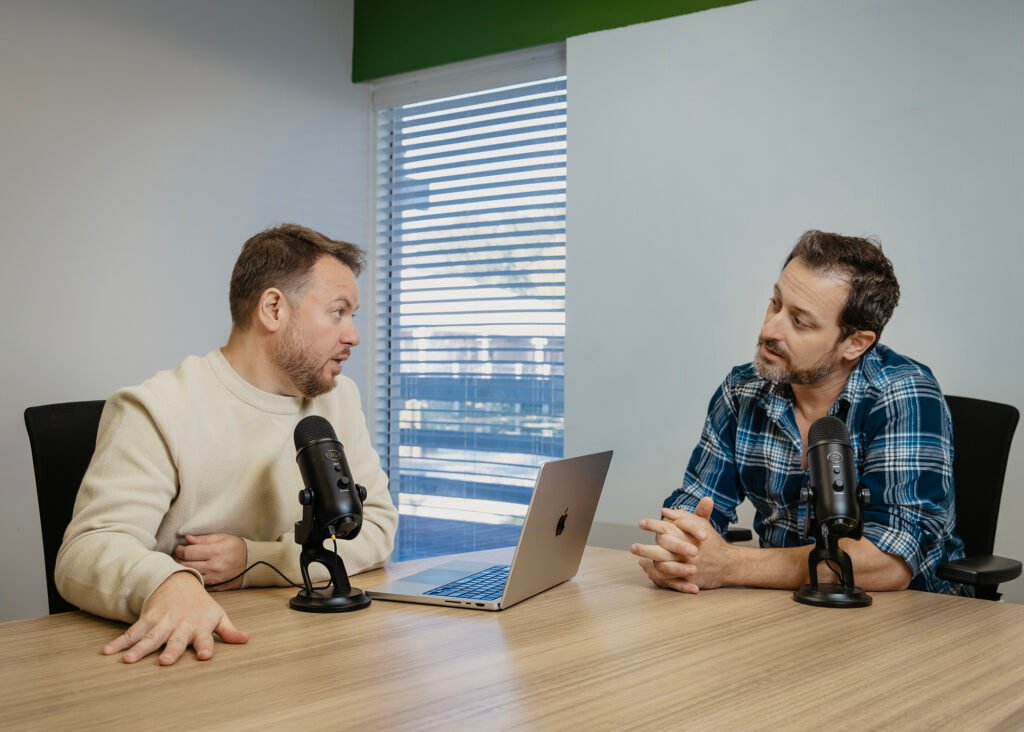
Episode Summary
For decades, business software has evolved through familiar interface eras: paper ledgers, desktop applications, SaaS dashboards, and mobile apps. But according to Justin Davis and Greg Ross-Munro, AI may be pushing us into an entirely new phase where interfaces become conversational, adaptive, and increasingly invisible. In this episode, the hosts examine what happens when users stop navigating software manually and instead simply ask systems for outcomes, insights, and decisions.
The conversation dives into the implications for SaaS companies, UX designers, software developers, and operational teams. Justin argues that traditional interfaces are often “a hack” standing between people and the answers they actually want, while Greg explores how AI-driven systems could fundamentally change the way businesses compete, train employees, and build products. They discuss why spreadsheets may never die, how AI is reshaping software development workflows, and why future competitive advantages may come not from feature lists, but from human taste, judgment, and creativity. The result is a candid and thought-provoking look at the possible collapse, reinvention, or explosion of UX in the age of AI.
Episode notes
- The evolution of interfaces from paper to desktop software to SaaS and AI
- Why traditional software interfaces may become obsolete
- The rise of conversational and AI-native workflows
- What “the collapse of the interface” could mean for SaaS products
- Why users do not actually want to “use software”
- The end of the feature arms race in software development
- How AI changes the role of UX designers and software engineers
- Why spreadsheets may survive forever
- The growing importance of human judgment, taste, and product strategy
- AI-assisted coding and building mobile apps without touching code
- The future role of middleware, orchestration, and systems thinking
- How future employees may learn software concepts differently
- Why unusual or highly creative interfaces may become competitive advantages again
- Real-world examples of AI tools embedded directly into Microsoft Copilot, Slack, and Teams
- Predictions about how businesses will interact with software over the next decade